Published study · First author · Basin futures
What a drier future could mean for water in the Ruzizi Basin
Climate projections do not provide a single forecast. They show a range of plausible futures. In the Ruzizi River Basin, those futures consistently point toward less rainfall, lower water yield, and a more demanding management problem.
Read the published paper ↗- Maximum rainfall decline
- −37.86%
- Water-yield decline
- −52.10%
- Mid-century window
- 2040—2069
- Late-century window
- 2070—2100
How to read these numbers: the two maximum declines above refer to the mid-century SSP5-8.5 case relative to the model’s historical baseline.
How does a change in climate travel through an entire river basin?
A decline in rainfall does not translate directly into the same percentage decline in usable water. Temperature, evapotranspiration, soils, groundwater, and the timing of rainfall all shape the basin response. This study asks how those interacting processes could change water availability in the transboundary Ruzizi Basin through the middle and end of the century.
Connecting global climate scenarios to basin hydrology
The study combines observed and satellite climate data with a multi-model ensemble of downscaled CMIP6 projections. The SWAT hydrological model translates those climate inputs into rainfall, evapotranspiration, runoff, lateral flow, water yield, and streamflow. Simulations compare a historical baseline with 2040–2069 and 2070–2100 under SSP2-4.5 and SSP5-8.5.
- CHIRPS
- CMIP6 · MME
- SWAT / SWAT-CUP
- SSP2-4.5 · SSP5-8.5
03 / Findings
From rainfall to river flow: a cascading response
The scenarios become consistently drier
Mean annual precipitation decreases across both scenarios and future periods. The largest reported reduction is 37.86% by mid-century under SSP5-8.5, relative to the historical baseline.
Water yield responds more strongly than rainfall
The projected mid-century reduction in annual water yield reaches 52.10% under SSP5-8.5. This larger hydrological response shows why rainfall change alone is an incomplete measure of future water availability.
The seasonal water balance also changes
The monthly analysis projects lower rainfall and water yield throughout the year, with changes in evapotranspiration and lateral flow. Management therefore needs to consider when water is available as well as the annual total.
Lower flows raise a transboundary management question
The paper reports lower projected discharge in the basin’s lower reaches. That matters for domestic and agricultural water, ecosystems, and hydropower, all of which depend on a river shared by the Democratic Republic of the Congo, Rwanda, and Burundi.
Read the projections
The monthly water balance under two climate pathways
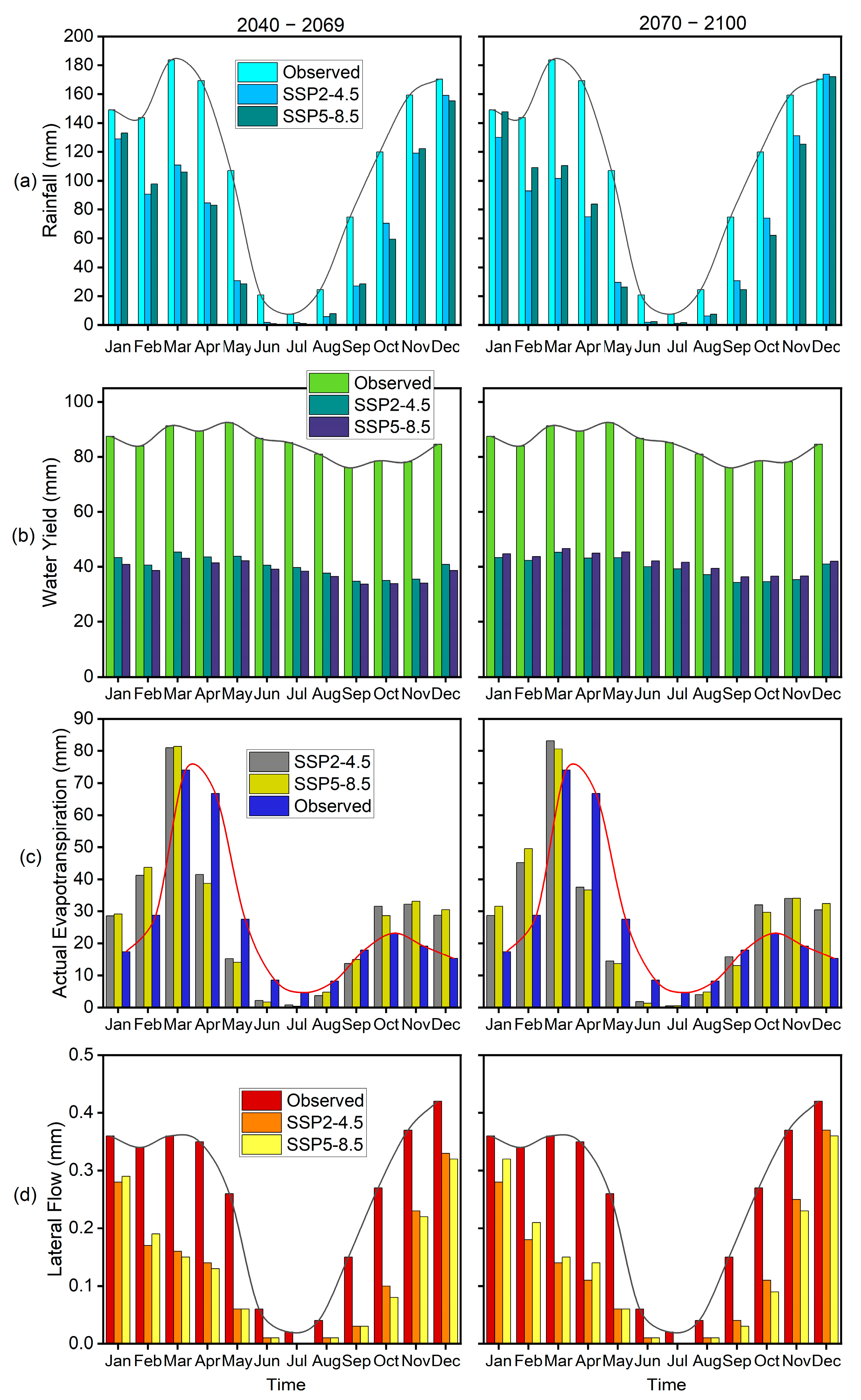
The left column shows the mid-century period and the right column the late-century period. Each row compares the historical baseline with SSP2-4.5 and SSP5-8.5 for rainfall, water yield, actual evapotranspiration, and lateral flow. The recurring separation between historical and projected water yield is the central signal.
Figure 6, Ahana et al. (2024). Reproduced unchanged; file format converted and display size adjusted. CC BY 4.0 · Source paper
04 / Contribution
My role as first author
This first-author paper anchors my work on climate change and water management in the Ruzizi Basin. It brings climate projections and basin modelling together to translate a global climate question into locally relevant evidence for water-resource decisions.
05 / Interpretation
These are conditional futures, not predictions
The results depend on the selected climate models, emissions pathways, downscaling, observed data, and SWAT representation of the basin. They describe what the model produces under stated assumptions; they do not predict a particular year’s rainfall or guarantee that one pathway will occur. Future land use, water demand, infrastructure, and management decisions can also change the outcome.
Publication
Water · 2024
Ahana, B. S., Nguyen, B. Q., Posite, V. R., Abdelbaki, C. & Kantoush, S. A. (2024). Future Projection of Water Resources of Ruzizi River Basin: What Are the Challenges for Management Strategy? Water, 16(19), 2783.