Is higher output a sign of a healthier plant?
Hydropower depends on both the amount of water passing through a plant and the height difference that gives that water its energy. That height difference is called hydraulic head. More water can support generation even while the available head declines. We examined Ruzizi I, a 29.8 MW plant downstream of Lake Kivu, to understand what this combination means for its operating efficiency.
Looking beyond electricity output
The study combines monthly operational records from SNEL for January 2000 to December 2023 with ERA5-Land climate data. Trend analysis, comparisons of drought and wet years, linear regression, Random Forest, and Gradient Boosting were used to examine efficiency and its relationship with flow, head, and plant availability. The efficiency measure compares electrical output with the hydraulic energy input at each monthly timestep.
What we found
Higher flow can conceal a loss of head
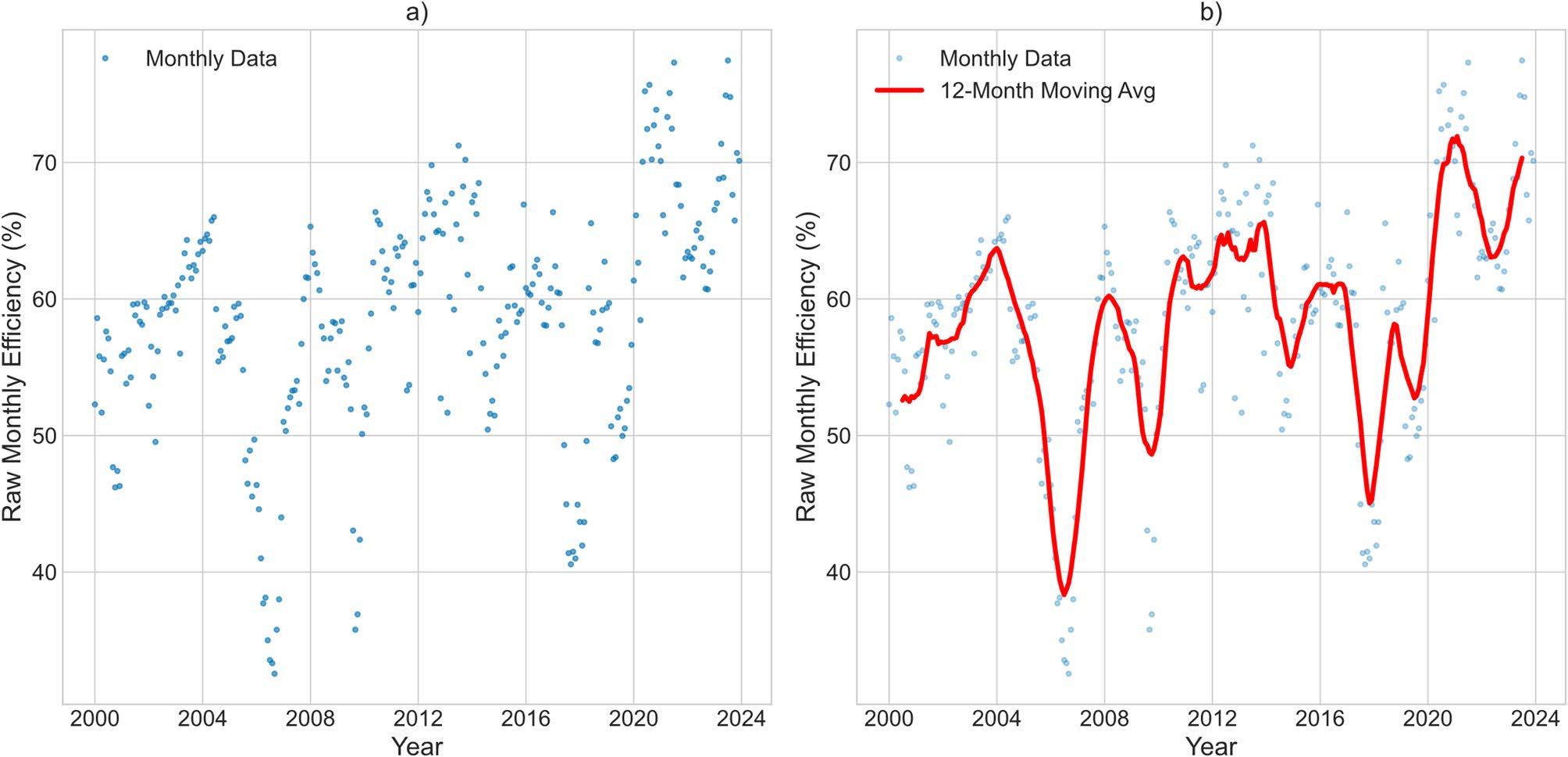
The paper reports an efficiency increase of about 3.6 percentage points per decade alongside a gross-head decline of about 0.20 metres per decade. Discharge dominated the observed monthly efficiency relationship. The authors interpret this as a masking effect: better headline performance does not mean hydraulic constraints have disappeared.
Lake Kivu changes the climate response
Efficiency during drought years was not statistically distinguishable from normal years, while wet years showed higher efficiency. The paper attributes this pattern to upstream storage in Lake Kivu. This is a historical finding for this lake-buffered plant, not a claim that hydropower is immune to drought or future climate change.
Operations offer a possible improvement
An observed load-factor band of 78–82% was associated with higher average efficiency. The study estimates a potential gain of roughly four percentage points relative to historical operation, but recommends testing it with real-time optimisation simulations. Declining available capacity also points to constraints beyond water supply.